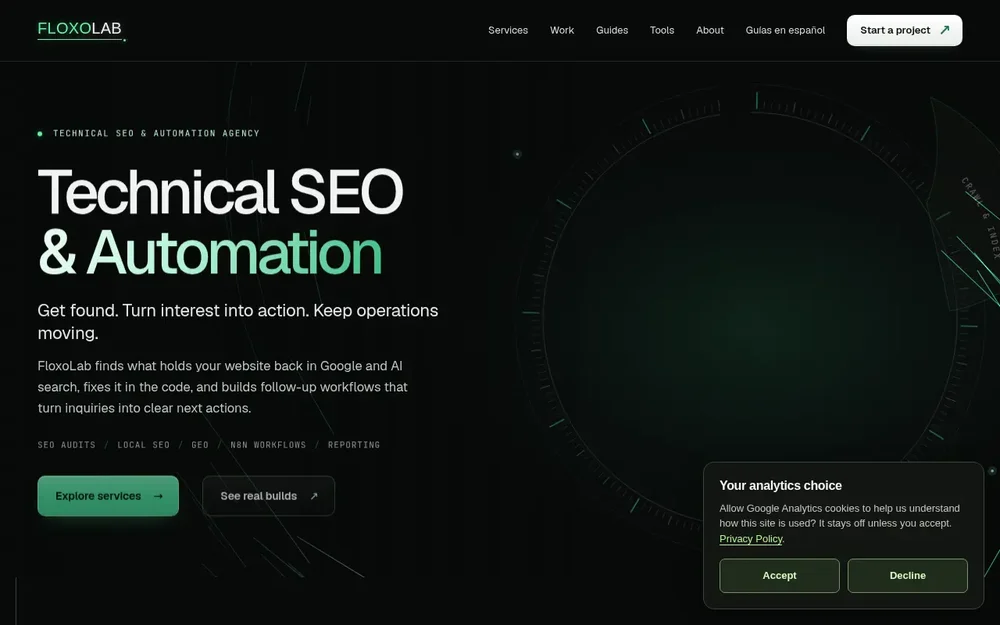
FloxoLab: Technical SEO & Automation
FloxoLab is an agency that connects technical SEO, search architecture, and workflow automation, taking work from strategy through implementation. It helps businesses address what keeps their websites from being discovered and understood in search, and links useful search signals and inquiries to practical next steps. Rather than treating SEO recommendations, website changes, and operations as separate concerns, FloxoLab brings them together: diagnose an issue, fix its source, and create a clear route for evidence or incoming work to reach the right person.
The work spans technical SEO implementation, content and search architecture, AI search measurement, automation, and lead systems. The common thread is attention to evidence and follow-through. A crawl or report is a starting point for investigation, not the final deliverable; an automated workflow includes validation and human review where needed. FloxoLab also publishes guides and examples that show methods and limits, giving prospective clients a way to inspect how the agency approaches specific problems.
Technical SEO that traces problems to their source
FloxoLab investigates crawlability, indexing, templates, rendering, redirects, internal paths, and performance. Its audit process brings together crawl data, Search Console reports, and live URLs to identify where evidence points to the same issue. It then traces repeated problems back to the template, rule, or code that creates them. That distinction matters: an exclusion in an indexing report, for example, should be checked to understand what is failing rather than treated as interchangeable with every other exclusion.
After identifying a cause, the agency can change the relevant source, such as a template, rendering behavior, redirect, internal path, or performance bottleneck. The process also includes post-release checks: re-crawl, inspect live URLs, and confirm whether the change held. FloxoLab presents technical SEO as implementation work, not just a list of warnings. Its offerings include a fixed-scope SEO audit with prioritized findings and monthly maintenance covering a bounded queue of fixes, checks, and upkeep.
Search architecture gives pages distinct roles
A site can have technically accessible pages and still leave their purpose or relationships unclear. FloxoLab’s search and content architecture work maps important pages to search intent, separates pages that compete for the same query, and connects commercial, supporting, and editorial content through useful internal paths. This can involve deciding whether an overlapping page should be merged, split, or redefined, rather than adding more pages without resolving the underlying conflict.
The agency describes page roles such as service pages for people looking to hire or compare, category pages for choosing a product type, topic hubs for grouping a subject, and guides intended to answer questions. Its illustrative structure shows a route from guide to hub to service, with supporting pages contributing examples or definitions. For ecommerce, the material also addresses faceted navigation and pagination, including whether a filtered view serves distinct demand. These are planning models and topics covered in its work and guides, not a promise that every site needs the same structure.
AI search visibility measured with dated evidence
FloxoLab also examines whether pages can be accessed by crawlers and whether AI search surfaces cite them for tracked prompts. Its measurement approach records the prompt, engine, date, location, and cited URL. It then uses those observations to inform a page-level decision, such as improving, expanding, monitoring, or leaving a page as it is. The agency emphasizes that a citation observation is a data point, not an AI ranking.
That caveat is central to the service: AI answers can vary by prompt, place, and day, so FloxoLab does not present a stable AI rank as a reportable metric. Instead, it checks accessibility, whether a page supports its claims, and whether a citation was observed for a tracked question. This helps keep AI search visibility work tied to recorded evidence rather than an invented position. Related guides cover AI search citations, visibility audits, and zero-click measurement.
Automation with validation and human review
FloxoLab builds workflows to connect repetitive work across tools, with validation, error handling, and clear ownership. Its examples show how a search signal can be accompanied by crawl and inspection evidence, reviewed by a person, and routed toward a source fix and later validation. A review gate can pause a process for approval instead of allowing an important change to continue automatically. The agency describes workflows as built for the specific site and around the tools already in use.
For inquiries, a workflow can check fields and duplicates, send exceptions to a person, and store a lead in a CRM with its source page and owner. A follow-up can then be routed with a due date. FloxoLab discusses n8n, Zapier, and Make as automation platforms, while noting their different roles in its tool guides; the source does not suggest that every client uses the same stack. A workflow audit is offered as a way to map one manual process before automation is undertaken. This makes it possible to consider the process and its exceptions before deciding what to connect.
Lead systems, placement checks, and practical fit
Lead systems are another part of FloxoLab’s connected approach: inquiries become structured records with source context, routing, ownership, and a defined next action. The agency also offers MentionProof, a free checker for backlink or PR placements that are already known. It checks a specified placement for a brand mention, link, destination, anchor text, and link marking. It does not discover backlinks, build links, or guarantee placements; when a publisher blocks a check, the result asks for manual review rather than reporting a missing link.
FloxoLab may suit teams looking for implementation as well as diagnosis across search and operations. Its stated ways to start include an SEO audit, a workflow audit, or monthly SEO maintenance, with larger work scoped after an initial engagement or conversation. The agency’s delivery outline covers agreeing on the problem and evidence, building in the actual code and tools, testing edge cases and failure paths, implementing, documenting ownership, and measuring with dated evidence. Prospective clients can also review its guides and workflow examples to understand the methods, tools, and limits relevant to their needs.